Before deployment
Step 01 · Prepare the kit
Glass-fibre rods and 3D-printed connector nodes arrive as a compact flat-pack kit. The restoration team prepares the site and decides where the new structure can best support coral growth.
How it works
Seaforms turns a single dive into a coral restoration project that lives on long after your holiday ends. Here’s the full process — from opening the kit to the moment the structure is colonised by its first fish.
The process
Three steps over a single dive trip — and decades of impact afterwards.
Before deployment
Step 01 · Prepare the kit
Glass-fibre rods and 3D-printed connector nodes arrive as a compact flat-pack kit. The restoration team prepares the site and decides where the new structure can best support coral growth.
At the restoration site
Step 02 · Build & place
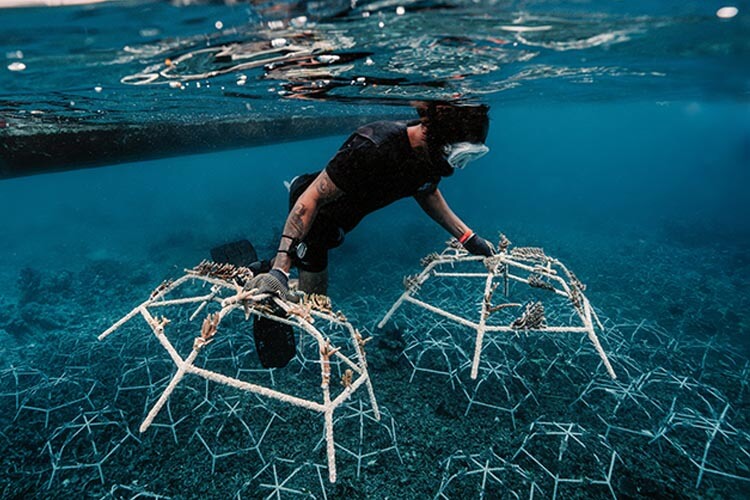
With guidance from the local restoration team, the glass-fibre rods click into 3D-printed nodes in about fifteen minutes. The completed PopStar is then anchored at the prepared reef site.
For years afterwards
Step 03 · Watch it grow
Every quarter the dive shop sends new photos of your reef. Coral colonies expand. Fish move in. Your Popstar shows up on the public Seaforms map forever — and you can share its profile link with anyone, anytime.
The PopStar
A reef-building kit of rust-free glass fibre rods and 3D-printed PETG connector nodes — shipped flat to any partner resort, assembled in about fifteen minutes in the field. Once anchored, coral colonises every surface of the structure. Within a few seasons a PopStar disappears into the reef it helped build: anchored at depth, overgrown, no longer something separate from the coral.
Common questions
For the deployment dive, yes — minimum Open Water (PADI/SSI/equivalent). The build itself happens on land and is open to anyone, including snorkellers travelling with a diving partner.
Each structure is engineered to withstand the local maximum-recorded wave conditions. If it's ever damaged, the resort reports back to you and the team rebuilds the affected section at no cost.
Yes. You get quarterly photo and video updates from the dive shop, plus a public profile page with the full history of your structure. You can share the link with anyone.
You're not paying someone else to do it. You physically build the structure with the marine team, learn the science, and your name stays on the structure for its full lifespan.
Some loss is expected — that's reef ecology. The dive team replaces failed fragments at the next monitoring visit, so your structure stays populated.
Kids 10+ can join the build session as observers. PADI Junior Open Water (10–14) divers can do the deployment dive at adapted depth. Younger kids snorkel above.
Free-floating plastic in the ocean is dangerous because marine animals mistake it for food, get entangled in it, or it breaks down into microplastics in the water column. PopStars do none of that. The structure is anchored at a designated restoration site, the printed connectors are sealed PETG rather than microplastic-shedding film or fragment plastic, and within a few seasons coral colonies grow over the entire structure — including the connectors — making them substrate inside the reef rather than debris floating around it. The alternative most degraded reefs face today is no restoration at all.
Public owner pages and field updates are rolling out in phases. Join the list and we will let you know when access opens more widely.